Knipex Alligator and Twin Grip: My Two Most-Used Pliers
Disclosure: I buy most of my own tools, and sometimes companies send me items to test. Nobody has ever paid me for an opinion. As an Amazon Associate I earn from qualifying purchases.
Real Tools. No Jokes. In my Knipex top five, two pliers came in near the top for daily use: the Alligator 88 01 250 and the Twin Grip 82 01 200. One handles pipe and general grabbing. The other turned broken bolts from a headache into almost a joy. Here is what each one does for me in industrial maintenance, and why I have kept both of them in the bag instead of picking one and moving on.
That video is my top five Knipex rundown, 5 Knipex Tools I Use Every Single Day. The Alligator and the Twin Grip are both in there, in my own order of most used to least used, because those are the two I keep reaching for when something is stuck, rounded, broken, or needs holding while I work on something else.
Knipex Alligator 88 01 250: My Most-Used Plier
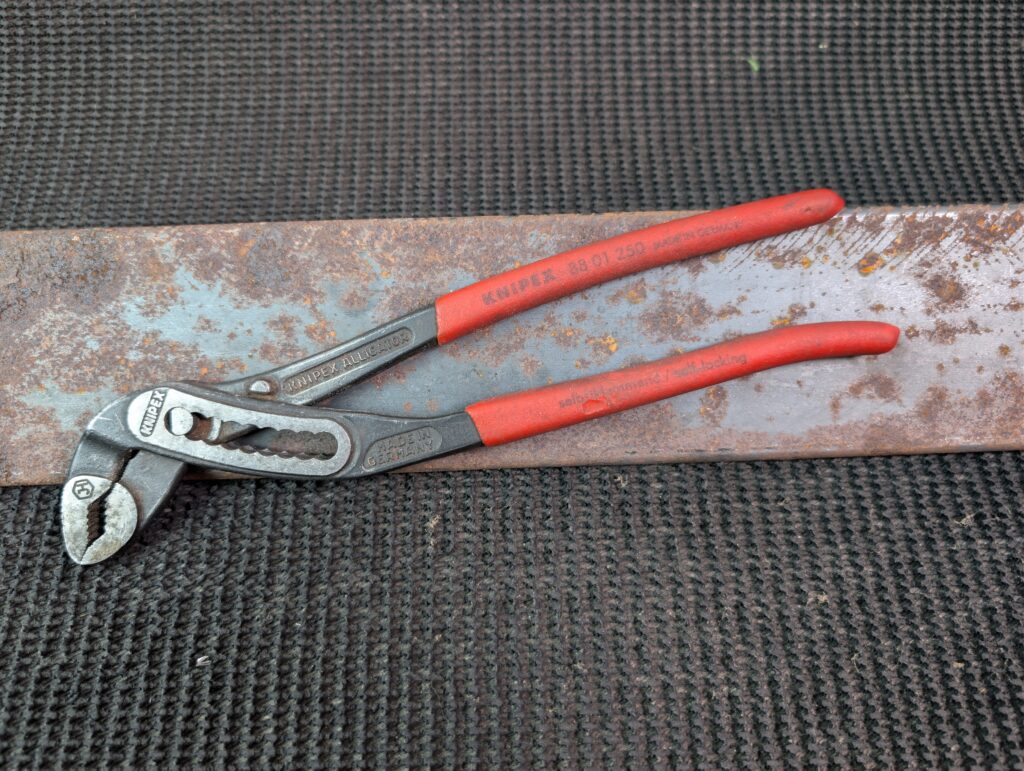
This is probably the one I use most: the Alligator in the 250 length, model 88 01 250. Mine does not have the push button. It is a slip joint, like the Channellocks I came from. Knipex does it a little differently, with two straps on the side and the pivoting bottom jaw hinge. It has the hooked head, the typical angled-head plier. When I first got them, I was not sure how much the slip joint would matter next to the push-button tools, but for this plier it never really did. I came straight from Channellock, where you do not have the button, it is just the slip joint, and the Alligator felt familiar in that way, just better made.
Man, making up pipe joints and connections, holding stuff, you know, you are tightening down jack bolts that the heads have been rounded off or whatever, all around handy set of pliers. That is the list, and it has not changed. I use it for making up pipe joints and connections, holding stuff while I work, and tightening jack bolts whose heads have been rounded off. It is not a specialty tool I bring out for one trick. It is the general grabber I trust when I do not know exactly what I am walking up to.
I’ve owned my Alligators about six-plus years now, and this is my oldest set of usable pliers. They are full of gunk, but they are still sharp and still bite into pipe. Still a great set of pliers. So probably my favorite all around and most used plier right there. That six-plus years matters to me more than how it felt on day one. Plenty of tools feel good new. This one has been used, gotten filthy, and the teeth still do what they are supposed to do on pipe.
Knipex Twin Grip 82 01 200: Broken Bolts Made Easy
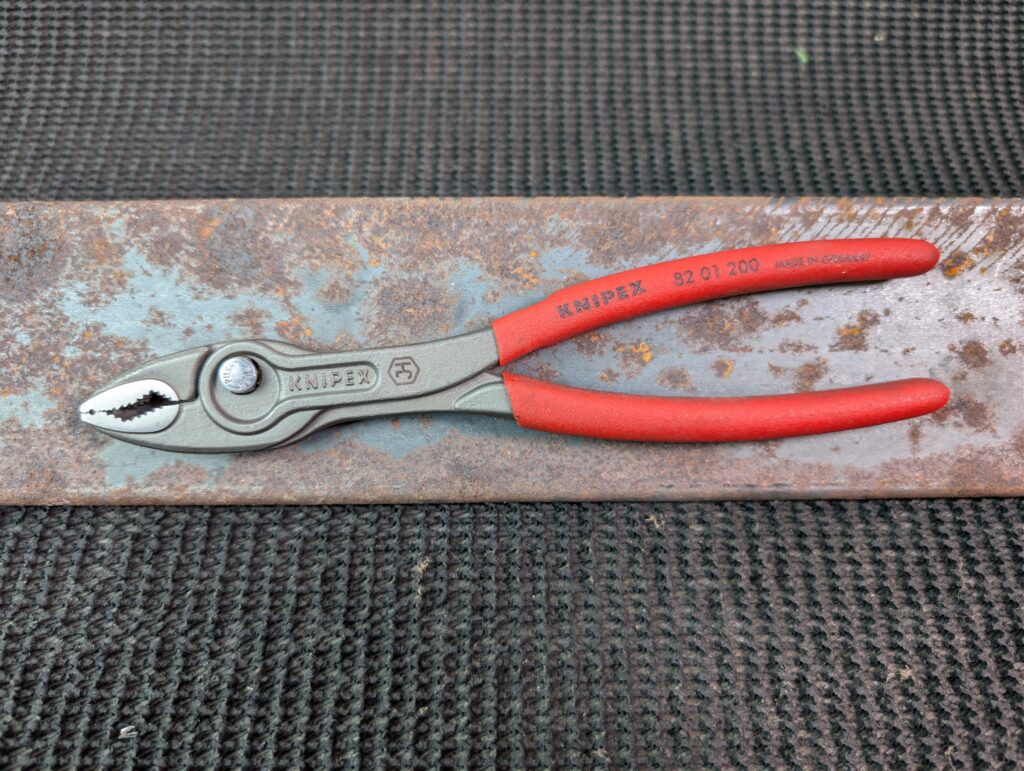
Next up, here is another one that opened my eyes up right here, the old Twin Grip. Standard, this is the 200 millimeter series, 82 01 200. Broken bolts have become almost a joy to deal with now. Broken studs, rounded-off bolts, rounded nuts, anything you need to get in there and get out. With the crazy end jaw teeth going across the other teeth, you grab something on the end and you can twist it out. It is super duper handy. The front jaw teeth run across the other teeth, so instead of only grabbing from the side like a regular plier, you can get on the end of whatever is broken and turn it.
And it is still a great pair of pliers in its regular configuration. That is the part people miss if they only hear broken bolts. In its regular configuration it is still a regular plier the rest of the time, so I am not carrying a one-job tool. Then I started using these on roller chain, and that was another eye opener right there. I started using the Twin Grip on roller chain too, and it gave me a second reason to keep it close. I will not dress that up into more than I said in the video. It worked, it surprised me, and it stayed in rotation.
For how I work a sheared bolt, step by step, see Broken Bolt Removal: Handy Tips That Actually Work on the Job. That post is the job walk-through. This one is why the Twin Grip is the plier I grab before I start that work.
| Alligator 88 01 250 | Twin Grip 82 01 200 | |
|---|---|---|
| Size | 250 mm (10 in) | 200 mm |
| Adjustment | Slip joint, no button | Push-button adjust |
| Jobs I use it for | Pipe joints, holding, rounded jack bolts | Broken bolts and studs, rounded nuts, roller chain |
| How much I use it | My most-used plier | Gets a lot of use |
Where they fit, and the size lesson I learned
Both are in my top 5 Knipex tools, along with the forged wire strippers, the pliers wrench, and my newest favorite, the Knipex Cobra ES. In the video I put the Alligator right up with my most used tools because, day in and day out in industrial maintenance, pipe, fittings, holding and rounded hardware show up more than the dramatic broken-bolt jobs do. The Twin Grip gets a lot of use too, just on a different kind of bad day.
I will admit I may have been overshooting myself with all the 10 inch stuff. I should have been down in the smaller ranges, a lot more useful a lot more now, on some jobs. The Twin Grip at 200 is a good reminder of that. It does the broken-bolt work without being the biggest plier in the bag, and the Alligator at 250 earns its size because it is the one making up pipe joints and holding bigger stuff. So I do not look at these two as duplicates. One is size and grip for everyday holding and pipe. The other is the end-grabbing jaw for hardware that is already broken or rounded, and it still works as a regular plier when it is not doing that.
My take if you are choosing
If you only get one, the Alligator 250 is my favorite all-around plier. It is the one I use most, and my oldest set, six-plus years in, still bites into pipe. If you deal with broken bolts and studs, rounded bolts and rounded nuts, the Twin Grip is the one that turned that job around for me, from a headache into almost a joy. That is not a rating, that is just where my hands go at work. Alligator for the everyday pipe and holding work. Twin Grip for the end of a broken bolt and for roller chain. I carry both because industrial maintenance hands me both kinds of jobs, sometimes on the same shift.