
Fluke T6-1000 PRO: The Simple Tester for Guys Who Aren’t Full-Time Electricians
Disclosure: I buy most of my own tools, and sometimes companies send me items to test. Nobody has ever paid me for an opinion. As an Amazon Associate I earn from qualifying purchases.
Real Tools. No Jokes. This one is for anybody who isn’t a full-time electrician: maintenance techs, guys doing car work and repair, even DIYers. Fluke makes a handy little electrical tester for when you don’t need to know every single detail of what you’re working on. If you’re designing circuits, this is probably a little rudimentary for you. But if you work like I do, checking fuses, checking continuity on wires, and taking AC and DC voltages, you don’t want to keep switching back and forth or stare at a dial full of readings. If you’re not an electrician by trade, you won’t know what all those extra settings mean. Microfarads and all that are a little beyond my workday duties.
Quick Verdict: Fluke T6-1000 PRO
Simple, easy to use, and it gives a lot of good readings without a dial full of settings.
- Three-position dial: voltage, FieldSense, ohms/continuity
- Auto-selects AC or DC
- Green backlight plus a beep on continuity, good in loud plants
- Hold button and Hz reading
- Holster keeps the leads tied up
- Not for circuit design or every detail. Look at other Fluke models for that
- FieldSense isn’t exact: Fluke states ±3%, and my extension-cord test read off
Best For: Maintenance techs, car work, DIY troubleshooting
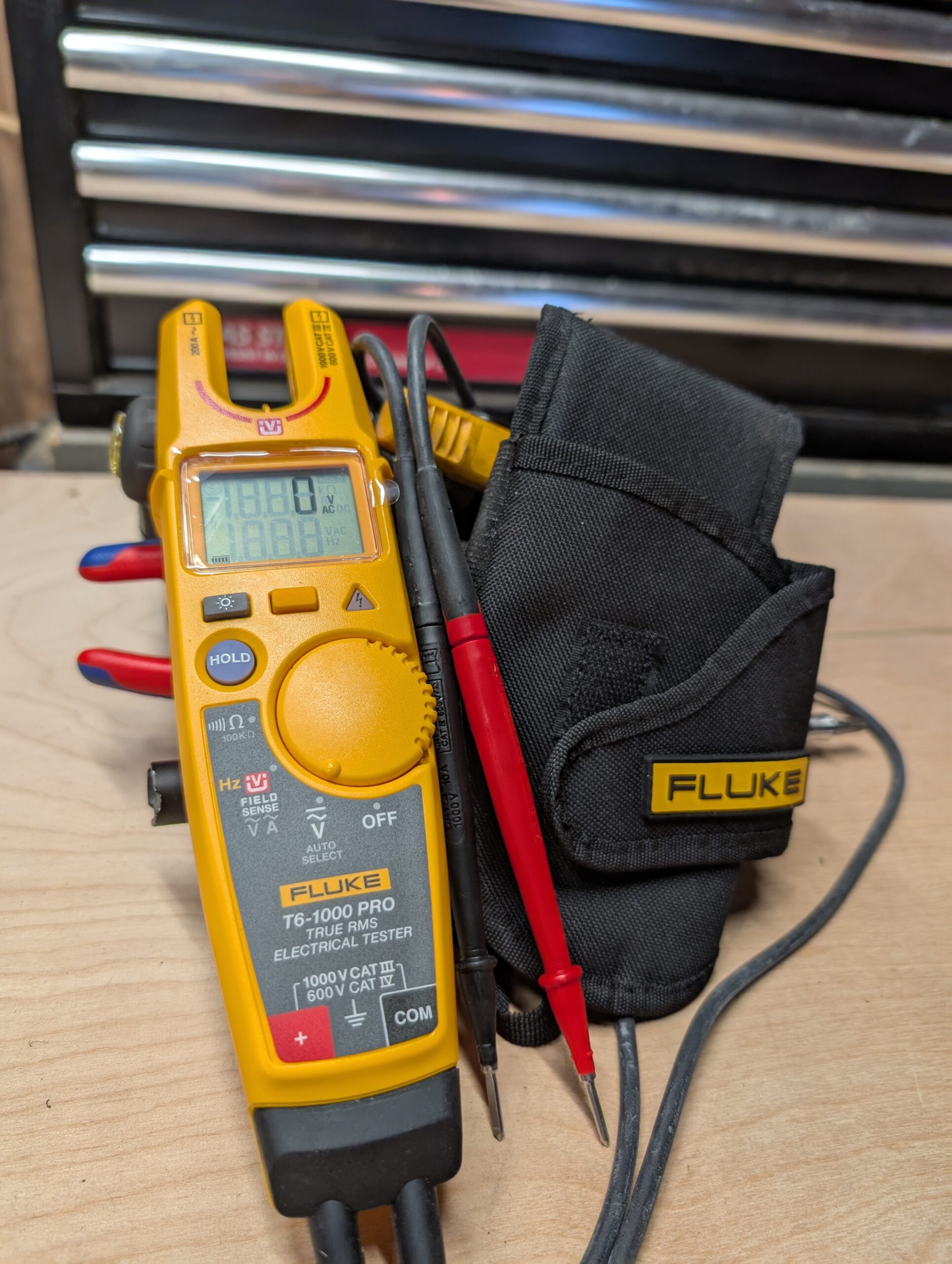
Three Settings and You’re Working
The dial has three settings. Voltage auto-selects AC or DC, and you can see the AC and DC symbols right above the V. FieldSense is a different kind of reading that tells you more than just whether you’ve got voltage. Ohms covers resistance and continuity, for when you want to know whether a wire is broken somewhere or a fuse is good. Basically, you’re making sure the circuit is complete and not open somewhere.
Auto AC/DC Voltage
Slip the leads out of the back and go. I put it on an 18-volt battery. It was sitting on 0 volts AC, and as soon as I touched positive and negative it jumped to 19 volts DC. That’s the auto-switching: it tells you what you’ve got without pushing a button every time you move to something new. On an extension cord plugged into the wall, it read 120 AC, and you also get a red light with the electrical symbol as a warning.
Fuses and Continuity on a 480 Plant Floor
Where I work it’s mostly 480, in industrial settings. Here’s a typical one: a motor driving a machine starts acting weird and sounding funny, and you suspect it’s single-phasing, with a leg out. You’ve got three matching fuses in a disconnect box somewhere, so you go check them. That one’s good. You check all three and make sure it’s not your fuses. The tester works one-handed, which helps there.
On continuity you get an audible beep and a green backlight. That green light is the part I like. The machines I work around run very loud, so you won’t hear the beep, but you can watch the screen go from open line to green. Checking a cable or a wire for a break works the same way. You make sure all your wires are getting power.
FieldSense, Hz and Hold
I don’t use FieldSense often. Most of the time we have good connections we can get to. But I can see using it on a long run of wire where you don’t have a good break to get a probe into. You ground off to the conduit, or the ground side if you’re in the electrical box. You can clip the lead on for one-handed use or use the probe. On my extension cord it showed 45 volts. That may not be right, because there was no load and all three conductors were running through there. On single conductors your readings would be pretty accurate. Fluke says FieldSense has a 3% variance either way.
For what I do, I don’t need the exact amperage and voltage. If you’ve been doing this long enough, you can tell when something looks off: if you’re expecting 270 and getting 25, something’s wrong. The backlight works on FieldSense too. If you want the Hz, you can switch it over and it shows 60 Hz at the bottom. There’s also a hold, so you can step back and write your readings down.
The Holster
It comes with a handy holster that keeps your leads tied up, which I think is one of the nicer little options. I usually keep my other meter in a hard case. In my bag, the leads get wrapped up with the other tools, and when you pull the meter out, everything comes with it.
Safety note: Don’t go playing around inside electrical boxes if you don’t have the experience. That goes double for industrial high voltage. You’re not going to like it if it happens.
| What I need | How the T6-1000 PRO handles it |
|---|---|
| AC or DC voltage | Auto-selects, no switching |
| Fuses and continuity | Beep plus green backlight |
| Loud machine areas | Watch for the green light |
| Long runs, no break point | FieldSense (approximate, ±3% per Fluke) |
| Recording readings | Hold button |
| Frequency | Shows Hz (60 Hz on my test) |
The Verdict
The Fluke T6-1000 PRO is simple and easy to use, and it gives you a lot of good readings. If you’re not trying to know every single thing about what you’re working on, it’s a good fit for maintenance, car work and DIY troubleshooting. If you need that level of detail, you should probably go with one of Fluke’s other models. For more electrical gear I use, see my Klein HD forged wire strippers review and my ratcheting screwdriver comparison, which covers which drivers fit into electrical boxes.