
If a new maintenance tech or a serious DIYer asked me what to buy, this is what I’d actually hand them. The complete first kit for a house is already up as The First 10. This list is narrower: eight tools I’d put in someone’s hand, all of them from reviews I’ve already published.
I’m a full-time industrial maintenance tech. These picks come out of that job, and out of tests I already wrote up on this site. For each one I’ll tell you the job it won, the honest downside, and who should skip it, and I’ll link the full review.
Disclosure: I buy my own tools. Companies sometimes send me items, but nobody pays for my opinions. As an Amazon Associate, I earn from qualifying purchases at no extra cost to you.
Eight tools from my own reviews. These are the ones I’d actually hand a new maintenance tech or a serious DIYer.
Best for: A gift, or a serious kit, built only from tools I’ve already used and written up.
1. Knipex Alligator 88 01 250
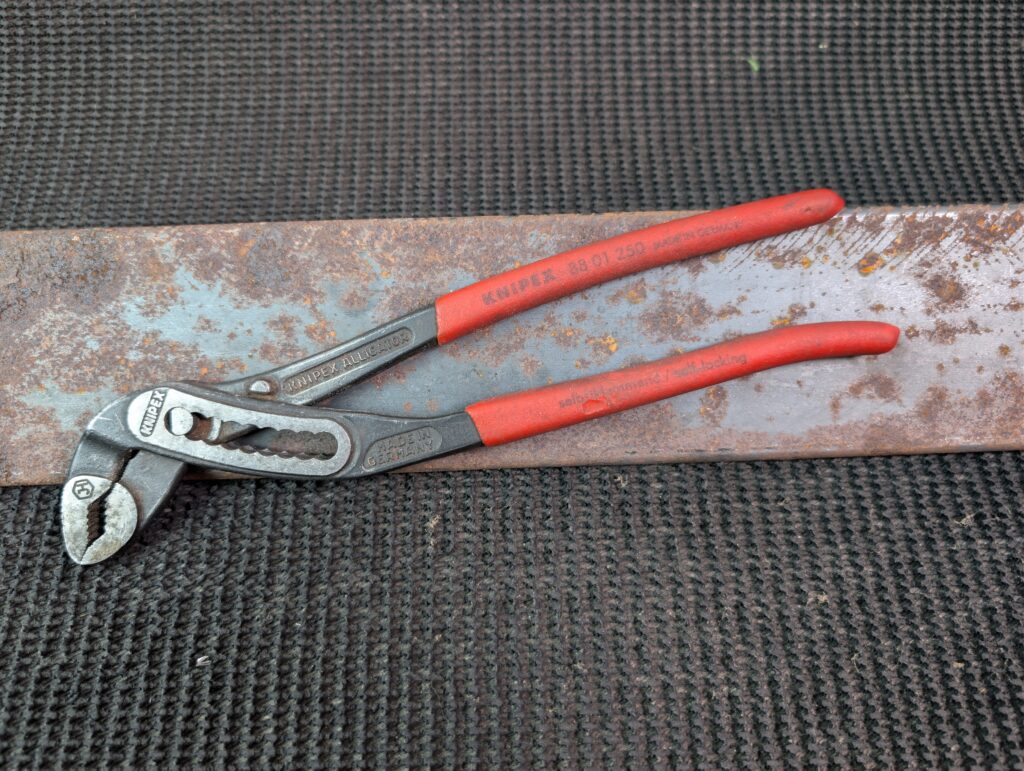
This was the first set of Knipex pliers I bought. I’ve had them about six-plus years now, and they are usually the first tool out of my bag. They’re full of gunk, and they still bite into pipe. Plenty of tools feel good new. This one has been used, gotten filthy, and the teeth still do what they’re supposed to do.
The job it won is the everyday one: making up pipe joints and connections, holding stuff while I work, and tightening jack bolts whose heads have been rounded off. Mine is the 250 length, a slip joint with no push button, two straps on the side, and the hooked, angled head. I came straight from Channellock, so the slip joint felt familiar, just better made. In my top 5 Knipex write-up I also noted the box-joint hinge, which keeps play down compared with a rivet that eventually wobbles.
The honest downside is the price. In that same top 5 I said they’re still an investment next to a big-box special, even if they aren’t much more than other premium pliers. I also said they’re honestly hard to fault on the tool itself. They just work.
Skip this if you’re only grabbing a fitting once or twice a year and the cost feels like too much for that. If you want one all-around plier, this is the one I’d give. The full write-up is my Alligator and Twin Grip review.
2. Knipex Twin Grip 82 01 200
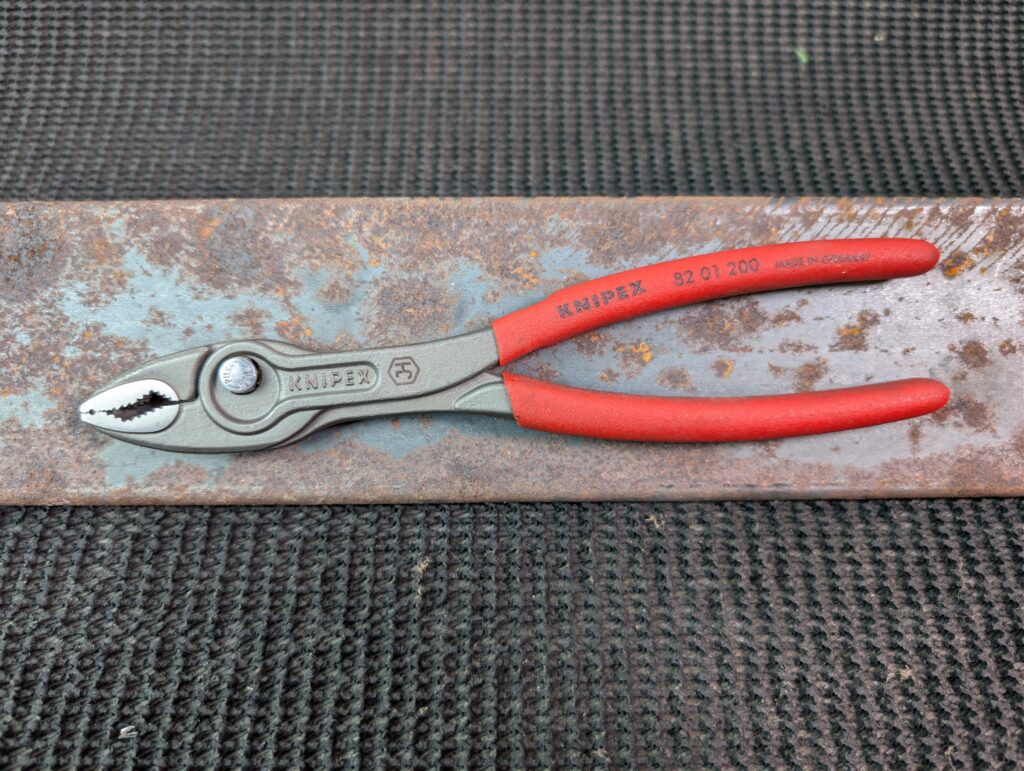
This is the 200 millimeter Twin Grip, model 82 01 200. Broken bolts became almost a joy to deal with once I had it: broken studs, rounded-off bolts, rounded nuts, anything you need to get on the end of and twist out. The front jaw teeth run across the other teeth, so you can grab from the end instead of only from the side.
It’s still a regular plier the rest of the time, with a push-button adjust, so I’m not carrying a one-job tool. I also started using it on roller chain, which gave me a second reason to keep it close. For the step-by-step on a sheared bolt, that’s in Broken Bolt Removal.
The honest downside, from the top 5 rundown, is that those extra teeth on the tip can get in the way of some standard plier work, and on irregular industrial shapes it can be hit or miss. If you only get one plier, I still point people at the Alligator.
Skip this if you never deal with rounded or broken hardware and you already have a good everyday slip-joint. If you do that work, or you want a smaller plier that still earns its keep as a regular grabber, this is the one I’d hand you. Same review as the Alligator: Knipex Alligator and Twin Grip.
3. Knipex Pliers Wrench 86 01 250
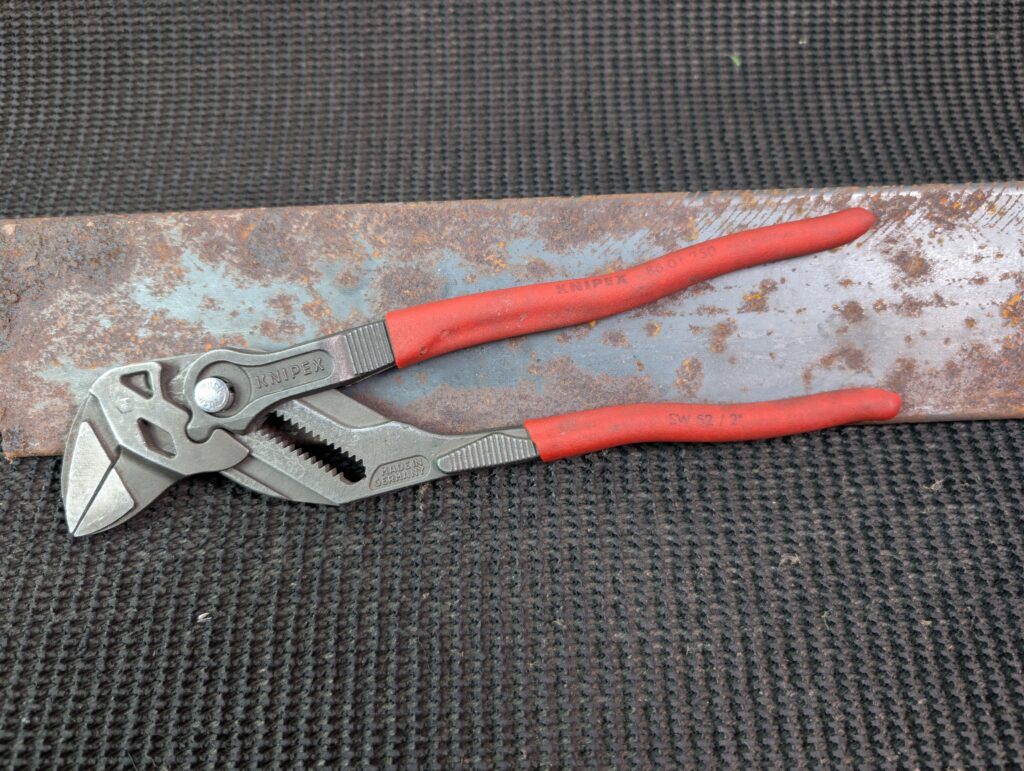
The pliers wrench is the hybrid I wrote up first in my top 5 Knipex tools. It works like a pair of pliers and grips like a precision wrench. You set the opening with the push-button, and it locks onto the fastener. Then it acts like a ratchet: you slightly open the jaw, rotate, and move to the next flat of the nut. I called it faster, tighter, and more reliable than a standard adjustable wrench.
The cam-action design means the harder you squeeze, the tighter it grips. The 10-inch model has a wider jaw opening than a standard 12-inch adjustable wrench, which is why this size is the one I’d give.
The honest downside is a learning curve. It isn’t as straightforward as a Crescent wrench, and it takes a few tries to get the ratcheting action down. The other downside is the price. These aren’t cheap. In that review I said a casual DIYer may find the cost hard to swallow, and that for the trade they pay for themselves.
Skip this if you only need an adjustable once in a while and you’d rather put the money toward a plier you’ll use every day. If you replace an adjustable often, or you want one tool that locks on and walks around a nut, this is the one. The full write-up is in that top 5 Knipex post.
4. Klein 32960ARCHT ratcheting Fast-Bit Tru-Grip
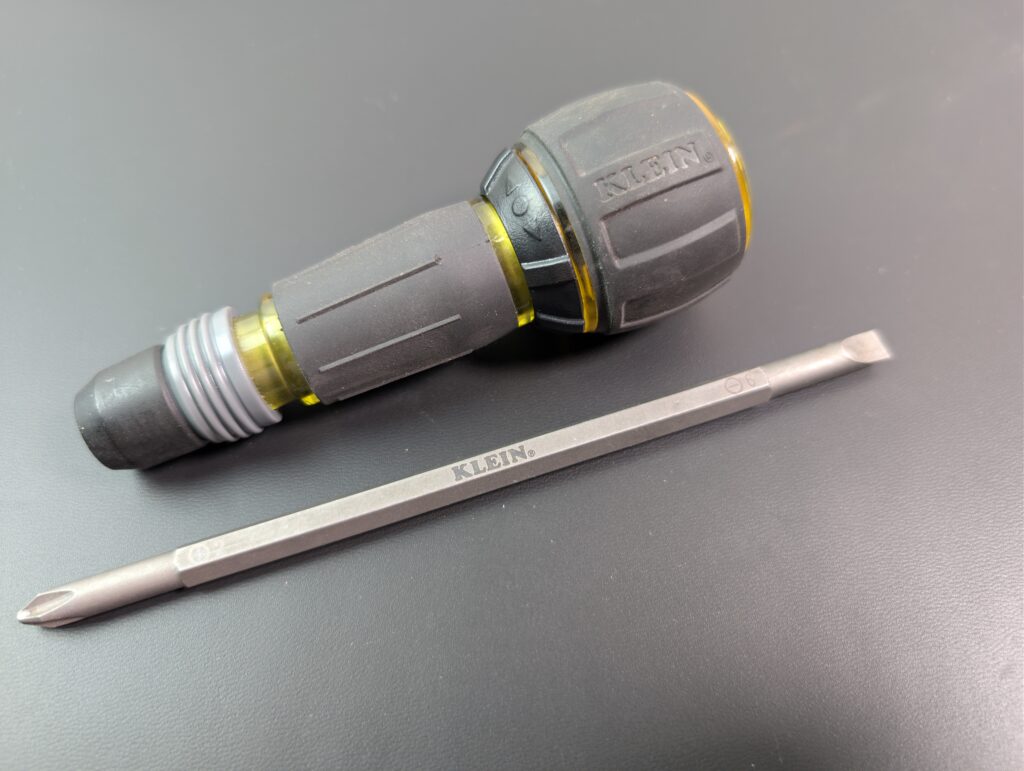
Klein sent me the 32960ARCHT to test. I already liked the regular Fast-Bit Tru-Grip, and I’d said that if it ratcheted, I’d love it even more. Now it does. The handle is a little longer than a ball grip, and it fits my hands better than the other two I compared it with. That’s the Anex 397-D and the Vessel 2200, both of which I bought myself. The full side-by-side is my ratcheting screwdriver comparison.
The job it won is daily work carry into electrical boxes, control panels, and contactor holders. The front end is slim enough to go down the hole, which the Vessel’s fat barrel can’t do. The new spring locking collar is a real upgrade: I used to knock bits out of the older Klein just walking by, and now you have to pull the collar back before the bit comes out. The direction switch takes a deliberate push. It didn’t flip on me the way the Vessel’s light switch does in normal use.
It takes standard 1/4-inch bits, and like the others you can pull the shaft and drop the bit into the handle for a stubby. On the ratchet, people talk a lot about the Klein’s lower tooth count. I carried it every day at work for about two weeks when I wrote that review, and it didn’t matter to me. Screws came out and went in. There is a little back drag. In stubby mode, the Klein’s bit hangs out a little more and doesn’t seat as deep as the Anex.
The Anex still wins on bit hold (almost a vacuum fit, and I’ve never had a bit fall out) and on ratchet feel, with almost no back drag and a recessed switch that stays put. At the time I wrote that comparison, both were in my daily carry at work. If your hands are like mine and grip is the first thing you judge, start with this Klein. If the finest ratchet feel and the tightest bit fit come first, look at the Anex 397-D.
Skip the Klein if the tightest bit fit and the smoothest ratchet are what you care about most. That’s the Anex. For a new tech, I’d start them on the Klein.
5. Fluke T6-1000 PRO

I wrote this one for people who aren’t full-time electricians: maintenance techs, people doing car work, even DIYers. If you’re designing circuits, it’s probably a little rudimentary, and you’d want another Fluke model. If you work like I do, checking fuses, checking continuity, and taking AC and DC voltages, you don’t want a dial full of settings you won’t use. The full review is my Fluke T6-1000 PRO write-up.
The dial has three positions: voltage, FieldSense, and ohms/continuity. Voltage auto-selects AC or DC. I put it on an 18-volt battery, and as soon as I touched positive and negative it jumped to 19 volts DC. On an extension cord it read 120 AC, with a red warning light. On continuity you get a beep and a green backlight. The machines I work around run very loud, so I often can’t hear the beep, and I watch the screen go green instead. It works one-handed, which helps when I’m checking three fuses in a disconnect and looking for a single-phased motor.
The honest downside is FieldSense. I don’t use it often, because most of the time we have a connection we can get a probe into. Fluke states FieldSense AC voltage accuracy of ±(3% + 3 counts), specified from 16 V to 1000 V. On my extension-cord test it showed 45 volts, which may not be right: there was no load, and all three conductors were running through there. On single conductors, I said the readings would be pretty accurate. It also isn’t the meter for every detail of a circuit. If that’s your work, look at Fluke’s other models.
It comes with a holster that keeps the leads tied up, a hold button so you can step back and write readings down, and a Hz reading (60 Hz on my test). Skip this if you need to design circuits or you already have a meter that does everything this one does. A safety note from that review, which I’ll repeat here: don’t go playing around inside electrical boxes if you don’t have the experience. That goes double for industrial high voltage.
6. TEKTON SKT15311 3/8" Drive 6-Point Socket Set (73-piece)

This is the set I’d give a serious DIYer for the garage, and a new tech as truck or backup coverage, not as the primary set on a plant cart. I said that straight in the Tekton 3/8-inch six-point review. It is a well-organized consumer set, chrome vanadium with a chrome-plated finish, in a case with size markings you can actually read.
The job it won is ordinary home and weekend work: brakes, battery swaps, lawnmower blades, a kid’s bike. Six-point sockets grab the flats on hex hardware instead of chewing the corners the way cheap twelve-point gear sometimes does. You’re not breaking loose 1-inch flange bolts with this, and that’s not what it’s for.
The honest downside is that it isn’t impact-rated for heavy production torque. If you need daily abuse on impacts and high-torque plant work, you need impact-rated gear, which this is not. The finish also needs basic rust prevention: keep it out of standing water, and hit it with WD-40 now and then. What stuck with me on the value side is Tekton’s warranty and customer service reputation, which matters when a socket breaks.
Skip this if you’re buying a main work set for impacts and plant torque. For the house, and as a backup in the truck, this is the one I’d hand over.
7. Klein Tools 56074 flat EDC flashlight
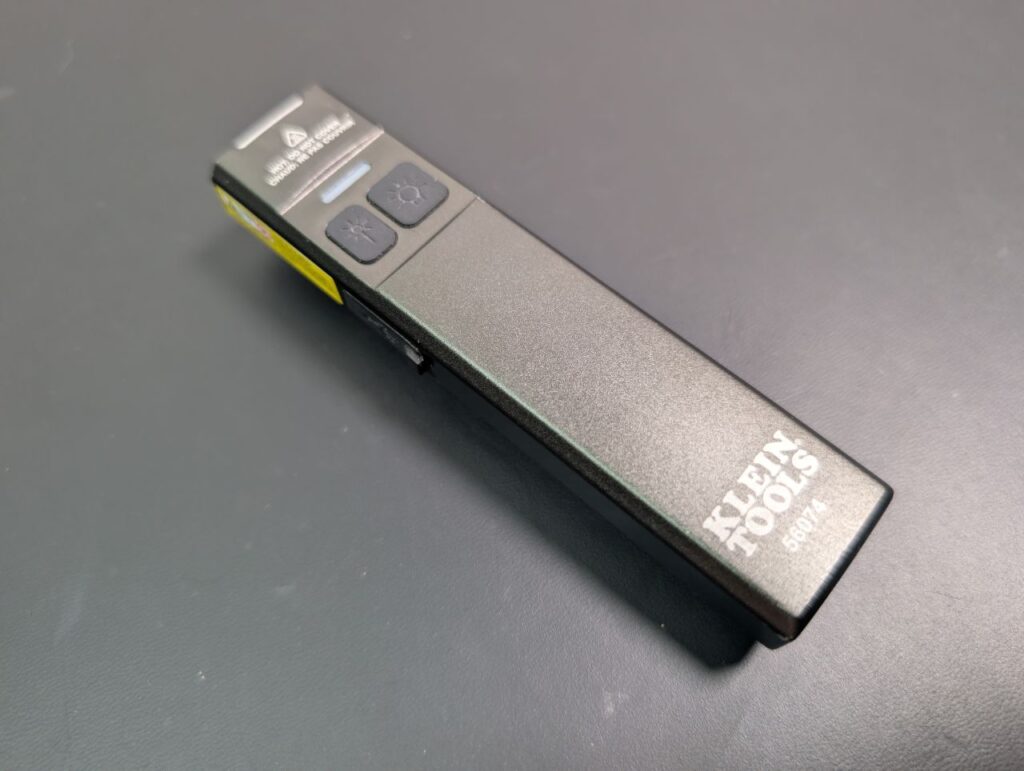
If you’re buying a first flat pocket light for work, this is the one I’d give. In my Sofirn ST1 vs Klein 56074 vs Olight ArkPro Ultra comparison, I said to stop at the Klein and put the extra money toward pliers that outlive these sealed batteries. It’s already in The First 10. Don’t mix it up with the Klein 56079 slim 360° work light already on this site. That’s a pivoting-head work lamp. The 56074 is the pocket flashlight.
I haven’t run a three-week bake-off on all three, and I don’t have lumen-meter logs, so the numbers below are published FL1 and maker specs, plus what those numbers mean on a shift. Klein built this for electricians and maintenance, not for 200-meter throw shots. You get a magnetic tail, a dual-way hat and pocket clip, an underside flood (around 150 lumens for about 12 hours, per that review), and a Class 2 green laser under 1 mW. FL1 high is 400 lumens for 3 hours, medium 200 for 5, low 100 for 8. Turbo is 1000 lumens for 60 seconds. Plan the job on high, not on turbo. It’s the lightest of those three at 2.72 oz (77 g).
The honest downsides are built into the design. The battery is sealed, about 1000 mAh, and a full USB-C charge takes about 3.5 hours. When that cell dies, you’re buying a new light. That’s true of all three in that comparison. It’s rated IP55 and a 2-meter drop, with an operating range of 32 to 104°F. Rain is fine. A soak is not. Turbo dumps for a minute, then you’re back on high.
Skip this if you want throw on a budget and you don’t need a magnet: that’s the Sofirn ST1, which has no magnet and a UI built more for flashlight people. Skip it if you want flood, spot, UV, and a pointer in one slab: that’s the Olight ArkPro Ultra, and its laser class (Class 1 or 3R, depending on the SKU) is a longer talk with a safety guy than Klein’s Class 2. For a maintenance tech’s pocket, I’d still hand them the 56074.
8. Klein K12075 Slim-Forged Wire Stripper/Cutter
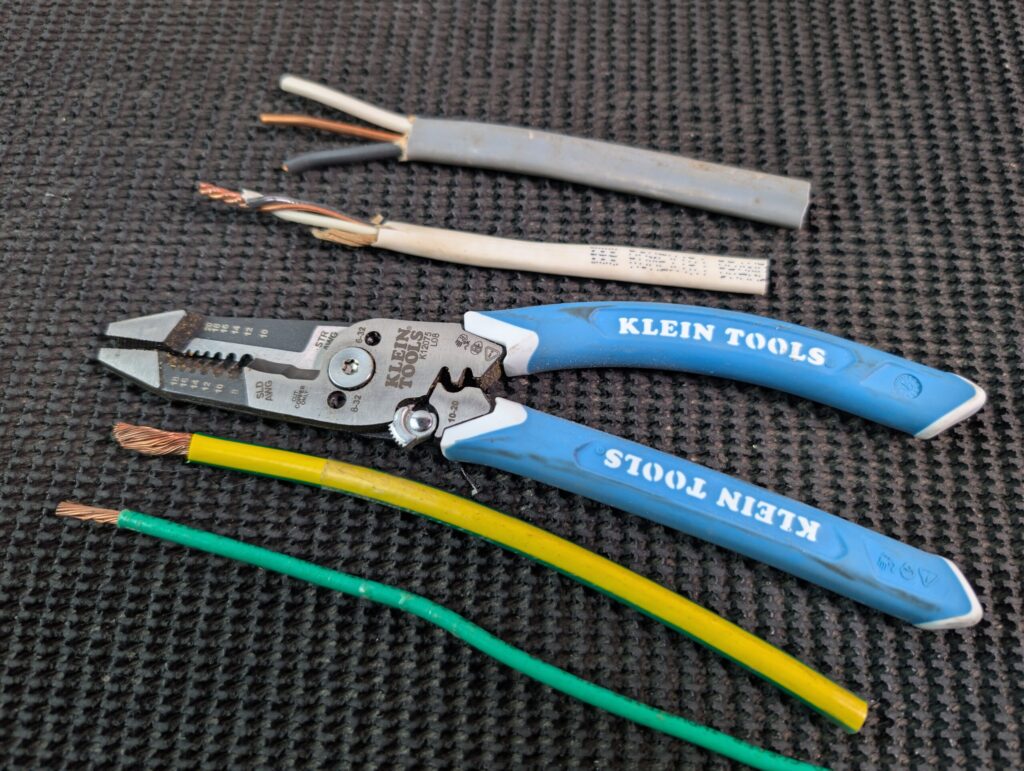
Klein supplied these for the review. I’m not a professional electrician. I’m a maintenance guy, and most of our wiring is point to point. I ran them through a live test: 14 and 10 Romex, number 10 stranded, some big stranded, and MC cable, which a commenter asked for. The full results are in my Klein HD forged wire strippers review.
Per the packaging, they handle 8 to 18 AWG solid and 10 to 20 AWG stranded. They cut, twist, and crimp, with bolt shears for 6-32 and 8-32 screws, six precision-ground stripping holes, and an internal spring that stays out of the way of the crimper. The crimper is for non-insulated connectors on 10 through 20 AWG stranded. The cutting blade has a little indentation that holds the wire so it doesn’t slip out. They’re made in Taiwan, with curved handles.
On 14 Romex, it cut all the way through all three conductors with hardly any effort, and the twist was almost effortless. On 10, which has more meat, it took a little more effort, still a smooth cut, without a lot of wrist strain. Stranded wire, including the big stuff, cut almost like nothing was there. After the test, the blade was still sharp, with no deformation and no damage. I also said that if I’d had these before my old stamped Kleins, my hands would probably be in better shape.
The honest downside is MC cable: these won’t open wide enough to cut it. My Knipex forged strippers will, if you open them like a hedge trimmer. The twisting grip is horizontal knurling only, so twists can slip. When I published that review, I was still taking them to work for a longer rundown.
Skip this if you cut MC regularly, or if a twisting grip that can slip is a deal-breaker. For maintenance and occasional wiring, this is the pair I’d give. They’re a better price than the Knipex forged strippers I already carry, and they earned a recommendation on the cuts I actually ran.
A few I left off
Three of these are Knipex, because those are the pliers I actually reach for. The rest fill jobs a new tech or a serious DIYer will hit: driving screws, checking voltage, having sockets for the house, lighting a dark box, and stripping wire. I left some other reviews off this list on purpose. The Knipex Cobra ES is excellent on roller chain and tight guards, but I wouldn’t give it as a first pipe plier. The Klein ratcheting wrenches and the Pack Mule Mini tool roll were first looks, and I haven’t called durability settled on the roll. Japanese tools from a later haul, and anything I haven’t used yet, stay off until they’ve been on the job.
If you’re building a first kit for the house, start with The First 10. The full reviews for everything above are linked in each section.
If you want the next one of these in your inbox, you can sign up for the newsletter at jestermetalworks.com/newsletter/.